
 Image 1 of 2
 Image 2 of 2
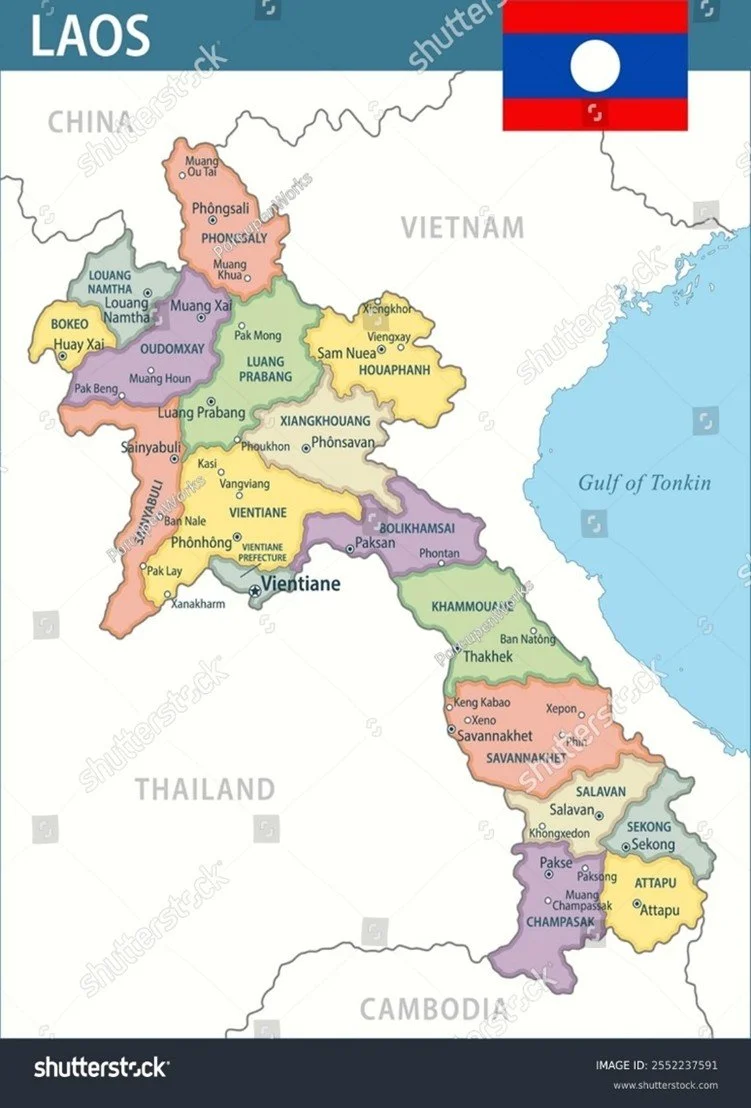
Approximately twice the size of Louisiana and landlocked, Laos is bordered to the north by China, northwest by Myanmar, west by Thailand, south by Cambodia and east by Vietnam. It’s history traces to the 13th century Kingdom of Lan Xang, translated “million elephants”, became a French Indochina protectorate in 1893, was under Japanese administration during WWII, declared its independence in 1945, was reoccupied by the French in 1946, deposed the French in 1953 during the Indochina War gaining independence as a constitutional monarchy, was occupied by North Vietnam during the Vietnam War resulting in the 1975 communist overthrow of the royalist government by the Lao People’s Revolutionary Party and remains one of the five remaining active communist states today. Obviously, a very superficial overview concerning a very complex portion of the world. Being a landlocked country in one of the most politically versatile geopolitical areas has many issues with a plethora of complications. Let’s hope for optimism.
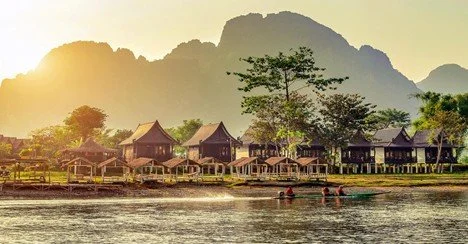
Coffee is a bright spot and, perhaps, can provide a soothing salve towards diplomacy. The Bolaven Plateau, located in Lao’s southernmost Champasak Provence, is approximately 130 miles north of Cambodia, 200 miles west of Vietnam, 60 miles east of Thailand and 950 miles south of China. It is here that French colonization contributed important agricultural techniques and the plateau’s volcanic soil provides the terroir resulting in 95% of the countries coffee cultivation. The Bolaven’s western border with Thailand is formed by the great Mekong River traveling 3,050 miles from the Tibetan Plateau’s Sanjiangyuan, translated “Source of Three Rivers” where the Yellow and Yangtze River’s also find their source, and terminating in Vietnam’s Mekong Delta on the South China Sea. The Bolaven’s Paksong District, referenced as Lao’s “Coffee Capital, is where our coffee is cultivated on a variety of small farms and processed at a central mill near the city of Paksong, the district capital. Very straight forward and possibly the most balanced of our selection… from roast to cup it really hits the sweet spot. The aroma has a cane syrup herbaceous sweetness… perhaps marjoram. The cup gives a moderate level of caramel and brown sugar sweetness leaning towards a high-ratio cacao dark chocolate. The finish leaves a hint of lemon rind. As the cup cools there is a transformation to a molasses toffee sweetness… perhaps some berry notes but we can’t put our finger on it. There are not many Laotian coffees available, so this is a treat. Hope to find another… Amy and I really enjoyed.
Process: Washed… removal of all cherry fruit with the bean dried
Elevation: 4000 feet