
 Image 1 of 2
 Image 2 of 2
Napolean Bonapart in 1803 lamented “Damn coffee! Damn colonies!” upon losing over 50,000 troops in a failed attempt to reestablish French dominance over Saint Domingue, after which the countries independence was proclaimed January 1, 1804 under the new name Haiti which is etymologically traced to the indigenous Taino language meaning “land of high mountains”. This crushed the French attempt to reestablish colonial ambitions and arguably provided the United States leverage in the 1803 Louisiana Purchase. Ironically, it was French Revolutionary fervor that inspired Toussaint Louverture’s generalship of the world’s sole victorious national slave revolute paving the road to freedom, the abolition of slavery and nationhood. Historically, with Columbus’ European discovery of December 6, 1492, Saint Domingue was not yet partitioned from the entire island initially proclaimed as Hispaniola, translated “The Spanish Island”. As the Spanish became more enamored with Central and South America, they largely abandoned the islands western third allowing the French to gain a foothold resulting in hostilities that were resolved in the 1697 Treaty of Ryswick with the division of Hispaniola’s western third as French Saint Domingue and eastern two thirds as Spanish Santo Domingo.
Between European discovery and independence, Haiti was regarded as perhaps the most historically vile slave colony with an estimated 10:1 slave to colonist proportion. Unfortunately, the country has since been plagued by political instability, international isolation, an 1821 costly failed invasion of the Dominican Republic, the 1825 French “150 million franc” extortion under threat of invasion resulting in dramatic international debt, the 1915-34 United States occupation, the 1957-86 “Papa” & ”Baby Doc” Duvalier authoritarian rule, the 2004 United Nations intervention, a catastrophic earthquake, a deadly cholera outbreak, and dramatic hurricane/weather related disasters. Although attempting to negotiate a democratic transition since the Duvalier authoritarian era, the country currently is considered a failed state due to assassination, political expulsion and mounting chaos. Organized criminal gangs control a majority of the capital Port-au-Prince and, with United Nations personnel evacuating coupled to failed peacekeeping efforts, appear poised to control the entire country. Once coined by the French as “La Perle des Antilles”, translated “Pearl of the Antilles”, due to the islands natural beauty and abundant wealth, Haiti now is a shattered remnant.
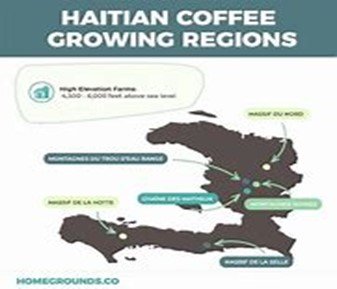
Although Haitian coffee’s future is unclear, we presently have a precious “pearl” in our Blue Norde. “Blue” is a homage to the similarity of growing conditions to the Jamaican Blue. “Norde” refers to the coffee’s northern cultivation in the Massif du Nord, translated “Northern Mass”, coffee region located in the longest Haitian mountain range of the same name. Nestled in this lush growing area is Dondon, around 50 miles due south of coastal Cap-Haitien, and the location of Coopacvod, loosely translated from Dutch as “Open Late”, Farms which I imagine refers to the late nights during the harvest. The farm is the country’s oldest cooperative comprised of approximately 850 members all dedicated to organically growing this Blue Norde sapphire. Okay, what makes Haitian, and Jamaican for that matter, Blue Mountain coffees special. Although the originating bean, Typica, is fantastic, it is the source for many other cultivar origins… Sumatra, Brazil, Costa Rica, Ethiopia, Central America, India and Guatemala. So, what is it? Like many great wines, teas, beers… it is location, location, location. Throw in the unwavering cultivation, quality control and sustainability practices of Coopacvod Farm and you have something that can’t be duplicated. I have heard the typical blow back… expensive, over-rated, coffee snob. True… somewhat expensive but sometimes the greats are just that. Over-rated… not if you take time to reflect. Coffee snob… that is just rude and hurts a little bit. For those that are willing to strap into the SR71 Blackbird and take a magical mystical ride at Mach 3 ½ will appreciate. The Jamaican Blue is really good… subtract a little savory while adding a little more buttery sweet creaminess and you have the Haitian. Which is best really depends on the up or down beat you are digging at the time. Either jazz pianists Bill Evans, with his harmonic sophistication, or Keith Jarrett, with his storied melodic soulful resonance. I love both pianist and both coffees… you just can’t go wrong with either gem. In the 1961 “Sinatra’s Swingin’ Session!!!”, we hear the “Chairman of the Board” croon of loneliness and the transformative power of love all wrapped in the rarest possibility of a “Blue Moon”. Grab that beautiful rainbow baby and swing baby swing.

Process: Washed… cherry removed before drying.
Elevation: 3950 feet